

How To Clean Up "Muddy Mixes" "Pdf"
We explore some of the most mutual causes of mix failure we've tackled in our monthly Mix Rescue cavalcade. Banish these demons and you're most of the way to a devilishly good mix!

Over the years, I've listened to piles and piles of amateur mixes from dwelling house studios, including thousands of productions submitted past SOS readers to Mix Rescue, Studio SOS, Demo Doctor (the predecessor of the electric current Playback column), and the My Sound Files section of the SOS forum. On height of that lot, I've heard almost every bit many mixes once again from students and teachers working in small higher studios. What I've learnt from all these mixes is that some problems crop up much more frequently than others.
What really crystalised this opinion for me recently was listening to over 100 mixes of the same raw multitrack files in order to adjudicate a recent 'mix‑off' competition. Considering anybody had worked from identical source fabric, the submissions clearly demonstrated that the aforementioned issues were undermining people's concluding results time and fourth dimension over again.
The purpose of this commodity, and so, is to reveal the most common of these recurring mix nightmares — and thereby help y'all to avoid them in your own projects. There'south simply and then much that text can tell you near mixing, though, so to make things clearer I'm going to refer to the aforementioned competition mixes by way of real‑world audio analogy — come across the '1 Vocal, 100 Mixes!' box for details of where you lot can listen to them. I've actually simply completed my own mix of that track, which will appear every bit a forthcoming Mix Rescue feature — so sentinel this space if you're smashing to know how I approached the rail myself! I've besides trawled through various articles in the SOS archives at www.soundonsound.com to create an on-line list of useful further reading, including several by Mix Rescues, which offering copious instance files, besides every bit links to useful software resource. See the 'Further Reading' box for details. Just now, without further ado, allow's reveal and rectify the nearly mutual rookie mistakes...
1: Dodgy Timing/Tuning
 Here'due south the waveform from a alive drummer's kick‑drum mic. Even though the office was recorded to a click rails, you lot can see that it naturally (and desirably!) deviates a niggling from the metric filigree.
This is probably the single about common weakness of dwelling house‑brew mixes. Like it or non, the public these days are used to unnaturally tight tuning and timing. A genuinely laid‑back experience is one thing, simply sloppiness in this department is 1 of the quickest means to make your mix sound like a demo. Unfortunately, a good 90 percentage of the amateur mixes I hear autumn at this hurdle, but because too petty care has been taken over such matters during rehearsals, tracking, overdubbing, and editing. Furthermore, of those home recordists who do really utilize some serious elbow grease here at the edit/mix stage, only a small proportion actually end upwards with really decent results, only considering information technology'southward so easy to mishandle the bachelor tools.
Now, I realise that some people take a pretty strong stance against the use of corrective measures like these, and probably the most frequent complaint is that such tactics kill the emotion in the music. My response is that adept cosmetic processing shouldn't do that, as it will merely target the inaccuracies that undermine the music, while leaving alone those that support it. To put it some other way: just because a few nutters go round stabbing people, it doesn't mean we should ban knives entirely! Clearly, y'all demand to be careful not to push your corrective mix procedures besides far, but my own feel suggests that the vast majority of domicile‑brew productions are in admittedly no danger of straying over that line. Here are some tips and tricks to help you lot get things right:
 Here you lot tin can see a pocket-sized section of the lead vocal function from SOS January 2011'southward Mix Rescue mix, in Celemony'southward Melodyne Editor pitch/time‑processing software. Although notes look out of melody, you lot can heed to the remix to confirm that they don't sound that way in the context of the runway. Timing correction isn't virtually quantising everything to your sequencer's bars‑and‑beats grid. Information technology'southward more about tightening up disagreements between the available parts in your arrangement. As such, your drum waveforms are usually a better visual guide for editing purposes than software bar/crush lines.Fully automatic pitch‑correction will nearly never reach an acceptable combination of tuning accuracy and musicality, so be prepared to spend some time manually finessing the activity of whatsoever pitch‑correction utilities you choose to employ.For timing purposes, the end‑betoken of a note can be nearly important as where it begins, peculiarly when yous're dealing with bass lines.Whether y'all're adjusting timing or tuning, avoid the powerful temptation to trust your optics over your ears. Although looking at software waveforms and pitch displays can help speed upwards corrective editing, information technology'south not at all uncommon for them to show some notes as 'correct' fifty-fifty when they're nevertheless audibly awry, and vice versa.It'due south particularly piece of cake to lose perspective while editing timing and tuning, so accept frequent breaks and make sure to listen to the runway at least once all the way through (preferably without looking at your computer screen) before signing off your edits.
Case Mixes: Although a majority of the contest submissions leave tuning pretty much untouched, there are nonetheless some mixes (17, 20 and 39, for instance) that make a pretty respectable job of it. None of the mixes quite tightens the timing plenty for me, though, which underlines how few pocket-size‑studio mix engineers realise the importance of this, for rock productions in detail.
2: Mix Tonality Misjudgements
 Don't compare the overall tonality of unlike mixes at just i volume level. Requite that monitor level control some do to get a more informed perspective.
  Plug‑ins such every bit Melda's MAutoEqualizer tin mensurate the overall frequency response of your whole mix, and so compare it with that of whatsoever commercial release. Although yous must always advisedly evaluate the results of any such software analysis past ear, it can be a useful reality check.
Anyone who'southward ever had their portable music histrion in shuffle manner should be aware that there's no standardised quantity of lows, mids, or highs in a commercial mix. That said, though, information technology's rarely sensible to endow your ain production with an overall tonality that makes it experience out of identify alongside comparable commercial tracks. Every bit such, it's every bit well to do at to the lowest degree some comparative checks against stylistically similar releases during the mixing phase to avoid whatsoever obvious tonal mismatch, even if you lot have the luxury of a good mastering engineer to refine this aspect of the sonics post‑mixdown — yous don't really want them applying drastic principal EQ, only because it volition nigh certainly upset your carefully crafted instrument balances.
Although I don't consider what I've just written to be tremendously contentious, information technology still surprises me how oft home mixers allow overall tonality problems to stymie their efforts. To some degree I suppose it's understandable, given that both the vagaries of low‑budget monitoring and the real‑time adaptability of the human hearing system can heavily disguise a skewed frequency response, preventing it from reaching the forefront of your attending. Those seem like flimsy excuses to me when there are so many cheap and like shooting fish in a barrel remedies on hand. Here are some useful pointers:
- Import several commercial mixes into a fresh project in your sequencer alongside a stereo bounce‑downwardly of your ain mix, and so switch between them instantaneously using the track solo buttons, and so that you throw the tonal differences into starkest relief. Utilise the track faders to recoup for loudness differences between the tracks.
- Compare mixes on more than one listening system, if possible, and at different playback volumes, to lay bare every bit many different tonal facets as possible.
- Go agree of some kind of high‑resolution frequency-analysis tool to provide you with extra data well-nigh the frequency spectrum. Voxengo's Bridge provides decent free spectrum-assay in plug‑in class, but if yous've got any upkeep available at all, I'd certainly recommend investigating some of the more sophisticated tools that allow you to capture a tonal fingerprint averaged over the whole rails — tools like the Melda MAutoEqualiser and Voxengo Curve EQ plug‑ins, or the off‑line Har-Bal software. Whatever any software tells you, though, exist very wary if it contradicts the show of your own ears.
- Fixing a broad tonal imbalance in your mix tin be as simple as inserting a loftier‑quality EQ plug‑in on your main channel. Nonetheless, if yous find yourself using more than three or iv EQ bands, applying more than iii‑4dB of gain per band, or using narrow filters (Q>i), information technology'due south more than than likely that your per‑channel EQ settings demand some reassessment as well.
Example Mixes: There is a huge tonal range to the contest mixes, despite the band having provided a detailed list of commercial reference productions. Compare the HF crispiness of mix 43 with the stifled highs of mixes 35 or 58, for case, or line upwards the powerful low cease of mix 32 with the slimline low frequencies in mixes 23 and 29. Mixes such as 19 and 43 have over-prominent mid-range, while others, such every bit 12 and 48, are recessed in that region. All that said, information technology's worth pointing out that fifty-fifty the mixes that feel most successful to me in this respect (mixes 04, 20, 31, 61 and 63, for instance) there is still a good caste of tonal variation — every mix doesn't take to sound exactly the same to tick this detail box, and in that location'south certainly some room for personal preference.
3: Phase Misalignment

If you use more than one mic to record any instrument, in that location'south e'er the danger that minute time‑delays between the recorded signals will cause a blazon of frequency cancellation called rummage‑filtering when the mics are combined at mixdown. Similar difficulties can also arise when combining mics with DI signals; when summing stereo mic pairs or send effects to mono; and when triggering samples alongside live parts. Most dwelling house‑studio folk underestimate the importance of dealing with phase mismatches, leading to mixes with hollowed‑out sounds and poor mono compatibility. However, at that place are now so many means to address phase issues in a typical MIDI + Sound sequencer — fine delays, audio editing, polarity inversion, all‑pass filtering, stage rotation — that there's really no need for comb‑filtering to rain on your parade. For improve results, try these tools and techniques:
- Listening to your mix in mono is a quick mode to check if whatever stereo indicate in your mix harbours phase problems. Although summing the left and right stereo channels of a mix will always cause a certain degree of tonal change, y'all demand to be on the lookout for any dramatic alterations that stand to brand a nonsense of your mix rest. If you do find phase gremlins, attempt applying phase‑adjustment techniques to 1 side of the offending stereo channel to improve the situation.
 The simple deed of switching your monitoring to mono can reveal all sorts of hidden phase conflicts in a stereo mix.
 - In that location are a number of defended stage‑adjustment plug‑ins worth investigating, including commercial products such as Audiocation'south Phase, Voxengo's PHA‑979 or Littlelabs' IBP Workstation (for the UAD2 platform), as well every bit freeware such every bit Betabugs' Phasebug and Diverseness Of Sound's new preFIX.
- Be careful when layering several bass parts or depression drum sounds within a single arrangement. Assuasive such layers to slip in and out of phase with each other is a recipe for frustration, because it'll cause the combined tone to modify sporadically throughout the timeline in a way that's almost impossible to gear up with normal mix processing.
Case Mixes: The multi‑miked guitar parts in the contest multitracks defenseless out a lot of contestants, who chose to pan the individual mic signals across the stereo field without stage‑aligning them beginning — compare mixes 36, 43, 58 and 59 in stereo and mono, for case, to hear what I mean. Phase cancellation betwixt the left and correct overhead mics caused mono‑compatibility bug too, as in mixes 33, 56 and 61.
4: Mix Mud
 There are several cracking plug-ins for adjusting phase relationships, and then at that place'southward really no alibi for letting comb filtering wreck your sonics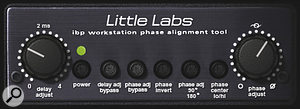

The lower half of the mix is ofttimes something of a boxing zone. Pretty much any track can contribute low‑end energy, but unless you're careful about which tracks you allow through in this range, it's very easy to stop up with a gloopy‑sounding mess that blurs the definition of your bass parts. The widespread use of close‑miking techniques is partly to blame for this common problem, because of the artificial bass boost (called the 'proximity effect') that well-nigh directional microphones impose nether such circumstances. Still, many constructed sounds and samples oft incorporate much more LF than is really required in a mix, also, and so programmed arrangements are no safer from this pitfall than live recordings. Try some of these tricks and see if things improve:
- Apply high‑pass filtering to any instrument that doesn't actually require low end for musical reasons. This will ensure that DC dissonance, traffic rumble, mic‑handling dissonance, and whatsoever other low‑octave rubbish doesn't interfere with your master bass parts.
- When setting filter frequencies, make certain to listen inside the context of the mix. You might be surprised by how far up the spectrum yous can go before the sound starts to lose warmth in context. Be conscientious with percussive sounds, though, as these can lose subjective punch well before overall tone seems to modify.
- Endeavor to funnel your different bass instruments into unlike frequency regions using pitch and EQ controls. The more these parts have to fight for the same infinite, the trickier it'll be to avoid murkiness.
- Be wary of delay or reverb effects that take ages to decay at the low end, considering they can quickly brand an unpalatably thick soup of your sonics. In typical popular, rock and electronica work, you can ordinarily afford to high‑pass filter most event returns well above 100Hz, too as applying boosted LF shelving or peaking cuts in the couple of octaves above that.
 Ane of the almost powerful weapons in the fight against dingy mixes is also ane of the simplest: high‑pass filtering.
Example Mixes: Although mix muddiness tends to be associated with a mix tonality that's heavy in the low-mid range, as in contest submissions 09, 54 and 58, say, brighter mixes such as 21, 22 and 36 are by no means immune to the aforementioned kind of clarity problem. Compare these to mixes such as 20, 31, 51 and 63, which handle this area of the spectrum much more than finer.
5: Unhelpful Arrangement
The roots of many a mix trouble tin can exist traced back to the musical organization, and this simple fact renders many of the budget productions I hear effectively unmixable. If your vocal's verse has more guitar or percussion layers than its chorus, you're probable to face an uphill struggle if you desire the chorus to arrive with a blindside. Also, there'southward no sense in having different guitar and keyboard sounds competing in the same pitch register if you want to go on any separation between them in the mix. And unless you lot create some sense of build‑up in the system itself, it's unlikely that you'll hold the listener'southward attending all the way to your last chorus. Here are some quick ways to make improvements:
- Attempt to avoid simply replicating the same organisation for any similar sections of your runway. Dropping a couple of parts from the beginning verse, for example, can aid brand the second verse feel a lot fresher and more engaging when it arrives.
- If you're having problem disentangling parts in your mix, try altering MIDI parts to different chord inversions or pitch‑shifting sound parts to unlike octave registers, to give each a scrap of clear space in the frequency spectrum. Alternatively, put one office'due south notes in the fourth dimension‑gaps left between the another part's notes.
 Rich reverb decays can quickly swamp your mix, particularly in modern upfront chart styles, and so effort shortening the effect's decay time if your mix is outset to feel undesirably murky.
 - Sometimes adding surreptitious overdubs or samples at the mixdown stage (or fifty-fifty editing out whole sections of the song!) is the best way to remedy an arrangement problem, so don't dominion out this kind of tactic at the mixdown stage.
Case Mixes
Although a lot of people did stick within the parameters of the multitracks provided, there were many instances where contestants practical artistic rearrangement techniques to tackle the mixing challenges presented past the supplied multitracks. Some mixers (most notably 03, 22, 27, 39 and 42) wielded the razor blade to increase the overall pace of development and to bring in the vocals earlier. Mixes eighteen and 52 wheel out a variety of more than extrovert mix effects as ear processed, while mixes 03, 18, 56, 59 and 61 make use of additional synth/sample textures to fill out the chorus texture or add together extra atmosphere during the verses. Vocals were frequently flown around to other parts of the mix and treated with pitch‑shifting to generate constructed harmony parts, as you tin can hear in mixes 05, 26 and 40, for instance, plus there are some interesting larger‑scale arrangement 'drops' showcased in mixes 27, 28 and 56. The most successful combination of all these dissimilar approaches for me, though, tin can exist heard in mix twenty — a version that but merely missed winning the contest outright.
vi: The Incorrect Reverb
 If the layout of audio in your DAW's primary window looks anything like this, with lots of elementary repetition of arrangement textures, so you lot'll about certainly struggle to build upwardly a sense of tension or momentum in the mix.
Reverb can practice and then many things in a mix: gelling sounds, changing timbres, simulating an acoustic environs, lengthening note decay. Equally such, one of the important tricks to using reverb successfully at mixdown is to concentrate on preventing information technology from doing things you don't actually want! Most dwelling house‑grown mixes have difficulties with this to some extent, with the issue that too much or too fiddling reverb is typically applied. After all, it stands to reason that if you try to alloy a sound into the mix with a reverb that's not good at blending things, say, so either you're going to stop short of the amount of blending yous need, or you're going to turn the result up to a indicate where its sound becomes overbearing in other ways. The following tips provide a useful guide to getting your reverbs right:
 To give you lot a trivial more than perspective on your effects settings during the concluding stages of a mix, effort muting each outcome render for a few seconds before returning it to the residuum. Once your ear has got used to the mix without the consequence, information technology's a lot easier to judge whether it'due south actually optimised for its purpose. Natural‑sounding reverbs will tend to be meliorate for blending sounds together and giving them a sense of space. Unnatural‑sounding reverbs (such as plates, springs and quirky algorithmic digital devices), on the other hand, will tend to offer more than scope for creative enhancement of instrument timbres.Bright effects usually sound more obvious at a lower level, then be prepared to ringlet off the high frequencies of effect returns if you want your reverbs to keep a lower contour.The length and level settings of a reverb are interdependent. If yous misjudge one of them, y'all'll struggle to find a satisfactory setting for the other.When you lot're close to completing your mix, bypass each return for a few seconds during playback. This can really help you to gauge whether each result is set up correct, especially in terms of overall tone, level and decay fourth dimension.If you're looking for a more up-front sound, using heavier pinch or adding in things like synth pads can both reduce the need for reverbs in a mix. Tempo‑sync'ed delay effects can too provide a more transparent substitute for reverb in a lot of cases.
  If your EQ settings await anything like the ones from this Mix Rescue submission, your mix is very likely to endure from the same harshness issues, because of the repeated emphasis on the 2‑5kHz region using comparatively CPU‑light processing.
Example Mixes: Mixes 17, 23 and 27 all have long reverb treatments that are rather besides prominent in the remainder, presumably in an attempt to gel the instruments and vocals together — a job that's usually more successful carried out with shorter, ambient‑fashion patches. (The reverb tails are also quite bright in these three mixes, which only reinforces the sense that the effects are beingness artificially generated.) Mix 16, on the other paw, has the reverse problem, in that it'south using too much short reverb to try to enhance musical instrument sustain and to create the illusion of a larger space. Hither, a few longer delays or reverbs would have been more constructive, allowing the blending treatment to assume a more natural‑sounding groundwork function. Mixes 06, 10 and 23 likewise employ likewise much reverb for me, and I call back that stronger use of compression would take been a better alternative, not to the lowest degree in fattening the drums and keeping the mix as a whole clearer and more than upfront.
seven: Harshness
 Every home studio should have at least 1 dedicated transient processor, if only because they tin deal with overly spiky acoustic recordings then transparently. In that location are now enough of plug‑in options to choose from, including SPL Transient Designer, Stillwell Audio Transient Monster, and Voxengo TransGainer shown here.
Any part of your mix that's rich in the 2‑5kHz frequencies will ordinarily sound closer to the listener, non least considering the human hearing organization is most sensitive to information in that region. Niggling surprise, and so, that so many home recordists pile masses of two‑5kHz on everything — vocals, guitars, drums, cymbals — with the result that the mix equally a whole ends up sounding harsh. However, it'southward non merely frequency response that can make a mix feel abrasive, considering untamed high‑frequency transients can exist some other crucial factor too. Here are some easy ways to avoid harshness in your mix:
- Endeavor to avert boosting in the 2‑5kHz region, especially with CPU‑light digital equalisers, which can occasionally audio a bit crunchy upwards top. If a given instrument isn't coming through well in that spectral area, apply some cuts to competing channels instead.
- Avoid EQ'ing in solo, because nigh people instinctively try to give every track a 'forrad' sound if they work like that. It'south what your tracks sound like in the context of the mix that really counts.
- If you want to move synth or electric‑guitar rhythm parts out of the harshness zone, try using pitch‑shifting or baloney to move some frequencies into a dissimilar role of the audio spectrum.
- Exist conscientious with the Set on Time control if you're compressing percussive textile heavily, considering slower settings tin let high‑level transients through the processing before the gain reduction has the risk to take hold.

- To tone downwardly overly spiky piano or acoustic‑guitar tracks, experiment with some of the dedicated transient processors now available, such as SPL's Transient Designer, Stillwell Audio'south Transient Monster, Sonnox Transient Modulator and Voxengo'southward Transgainer. Because these don't rely on a threshold system to work, they tend to deal with the problem more 'musically' than traditional dynamics units.
Example Mixes: Given that the competition multitrack combined thrashy drums and heavily overdriven electrical guitars, it's trivial surprise that many of the submitted mixes endure from harshness problems. Take mixes such as thirteen, 27 and 54, for instance: despite the considerable variance in their overall mix tonalities, they all share the kind of upper mid-range emphasis that chop-chop becomes a bit grating on the ear, particularly when the extra guitar layers hitting during the middle section. Overly sharp snare transients are also a bit hard on the ear in mixes such as 24, 34 and 56.
eight: Buried Details

Even in cases where the mix tone is free of muddiness and ship effects accept been practical appropriately, musicians who mix at dwelling rarely present their textile in the all-time light, simply because they don't actively directly the listener towards the music's most highly-seasoned aspects from moment to moment. Aye, the bass part might be dull every bit ditchwater most of the fourth dimension, but that doesn't hateful you can't push up the fader for its one petty make full if in that location'due south nothing else more thrilling happening at that fourth dimension. Any and all parts can do good from micro‑level fader rides like this, merely few tracks more so than lead vocals, where riding up the details tin can mean the difference between the listener understanding the lyrics and not. Here are some useful tricks to focus on all those lovely little details:
- Whether the primary role in your mix is a pb vocal, instrumental solo, or some other hook, it's not unusual for it to have the odd lull — a insufficiently featureless sustained note, say, or a gap between phrases. Whenever you hear one of these, have a quick hunt amongst the rest of the bankroll tracks to run into if there'south annihilation else that might briefly poke out of the texture to provide some welcome diversion.
- Turning down a couple of bankroll parts underneath a lead vocal line can assistance reveal more of the singer's subtle song inflections without recourse to nuclear‑course song compression.
- It's standard exercise on a professional person level to carefully automate atomic number 82 vocals in order to maximise the intelligibility of the lyrics, and then don't forget to give that process the time it needs. While you're at it, try fading upwardly the ends of some of the note tails — yous'd be surprised how oft they contain characterful little bits of hidden phrasing that can really make a performance seem more than emotional.
 Here you can see a department of the Mix Rescue remix project from Baronial 2009. Notice how the pianoforte (blue) backing level is being faded upwards betwixt the song phrases (red) to help direct the listener's ear in that direction whenever the vocal interest wanes.
Example Mixes: When someone's using detailed automation carefully, it'southward usually catchy to hear what'south going on in absolute terms — in other words, y'all shouldn't get an agile sense of faders being waggled most if the engineer knows what they're doing! What yous should become, though, is a sense of the music being easier to follow and more engaging from moment to moment, something which is most apparent in mixes 20, 31 and 63, all of which made my ain shortlist. Nonetheless, to be honest, none of the contest entries really shone in this area, which only serves to highlight how unremarkably the importance of micro‑level automation is underestimated.
9: Weak Payoffs
 These 2 screens show the level of detail that goes into song automation on today's commercial chart productions. The lower, right-mitt screen is from Fraser T Smith'due south mix of Tynchy Stryder's 'Number One', and the upper one from Greg Kurstin's mix of Lily Allen's 'The Fear'. That's what you're up against!
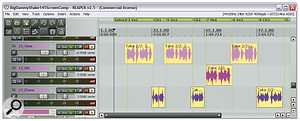 Any important instrumental or vocal office in your mix may well crave different mix treatment to cater for the balance demands of different sections of the musical organization. If so, so 'multing' the recording, past editing sections of it to separate tracks in your DAW (as shown hither), is a simple way to manage the practicalities.
Anyone who'southward ever mixed a song will at some time have come up upwards confronting the problem that their choruses audio underwhelming compared with their verses — or, to put information technology in more full general terms, that some section of the arrangement isn't delivering the required emotional payoff. There can be lots of reasons for this kind of 'long‑term dynamics' problem, but the near key i is failing to step the mix's build‑up correctly, such that the sonics peak also early. In this situation, the temptation is always to endeavour to push button the subjective 'size' of a mix'south climaxes beyond the point where they sound their all-time, thereby introducing all sorts of potentially unmusical processing and distortion side‑effects. Here are some ideas to help yous attain the bear on you want from a tune:
- If you feel that a section of your vocal is still failing to deliver the goods, even later on you've taken its sonics as far as you reasonably can, why non try working backwards? See if you can make the previous section smaller‑sounding, in some way, than it currently is.
- Remember that different songs, and different mix sections within a song, may need different sounds from the same instrument. A ballad'due south solo piano introduction, for example, will probably require a much fuller sound than the piano vamping tucked into a full‑band stone rhythm conditioning. Splitting your recordings beyond unlike tracks with audio editing (sometimes referred to equally multing) is a elementary style of implementing this thought, as you don't need to automate all the processing, simply do the mutes!
 Although applying depression midrange boost to a lead vocal, as in this screenshot, can give information technology a warm and intimate character, the danger is that information technology tin can also make the residual of the backing track sound modest, so any such boost needs to exist handled with care.
 - Both the level and the timbre of your lead vocals will be critical to the perceived ability of the backing organization. In particular, if you fade the song besides high up in the remainder, or give it too much lower mid-range, the chances are that it will start to make the residual of the production audio small.
Instance Mixes: Managing the long‑term dynamics of this detail mix was probably the greatest challenge presented past the competition multitracks, the crux of the matter existence that the middle department, with its strident additional guitar overdubs, tended to make the onset of the subsequent final chorus feel like something of a letdown — as in mixes 21 and 64, for example. Increasing the chorus vocal levels is the tactic taken by mixes 17 and 28, only this isn't actually that successful, as it makes the band sound rather pocket-sized by comparison with the singer. Mixes 22 and 33 thicken the chorus texture using additional baloney and widening effects respectively, merely autumn slightly foul of harshness and mono incompatibility into the bargain. More successful, to my ears, are mixes such as 38 and 46, which seemed to deliberately restrain the eye‑section's guitars (so that the chorus can still trump them in some way) or those which surreptitiously inflate the last chorus with actress textural layers — mixes 03, 07, or 20, for instance. At that place is also some excellent lateral‑thinking from mixes 20 (in its second version), 27, and 58, all of which utilize edited‑together organisation drops as a means of partially side‑stepping the whole consequence.
10: Inappropriate Processing On The Mix Coach
 It's tempting to try to ameliorate your sound by applying mastering‑style processes, such equally multi-band dynamics or loudness maximisation, to your output bus during mixdown, but it's seldom a good thought in practice! This kind of processing usually confuses about mix decisions completely, and you cease up chasing your tail — so while they're useful tools, information technology's better to get out them alone until you've finished the mix!
This one is a bit of a tightrope, because in that location are two different ways you lot can come a cropper. On the ane hand, it can be incommunicable to achieve the necessary degree of mix 'gum' and/or aggression in certain mod styles without a generous helping of dynamics processing over your master aqueduct; simply on the other mitt, you can get into all sorts of difficulties if you effectively try to main your product while you're still mixing it. Follow this advice and you should get better results:
Case Mixes: Many of the competition mixes didn't seem to use plenty bus compression to suit the ambitious musical style — mixes 05 and 30, for instance, or even the overall contest winner, mix 63. In the circumstances, something more along the lines of mix 31 or 33 feels near right to me. At that place were likewise inevitably people who drove their master processing considerably harder, though, such every bit in mixes 26 and 52, both of which feel rather overbearing as far as level pumping is concerned, while introducing undesirable transient side‑furnishings and distortion products. Mixes 50 and 58 are also over-compressed, for me, because their fast‑assault processing irons out much of the brusque‑term dynamics excitement and dulls the transient definition. Mix 42 is pretty much ruined by its heavy‑handed multi‑ring dynamics, which is a shame, as it turns out that the unprocessed version subsequently submitted has a lot to recommend it.
One Song, 100 Mixes!
 The competition mixes I've used every bit audio illustrations in this article were carried out in March and April this twelvemonth for a contest at www.Mixoff.org, a site that's home to a family of mixing collaboration forums. The song 'Blood To Bone', by a talented alt‑rock ring called Young Griffo, was provided in raw multitrack form for anyone on the forum to download, and I agreed to provide a detailed critique of any mix submitted within the starting time couple of weeks. In the end, more than 100 mixes were supplied, of which I critiqued around threescore, and I've since consolidated them all to a dedicated web folio, so that it's easy to listen to any of them and read the critiques aslope. Y'all tin can even still download the raw multitracks if you fancy having a crack at them yourself!
world wide web.cambridge-mt.com/YoungGriffoCompetition.htm.
Monitoring
 A specialised single‑driver mixing speaker, such as Pyramid's Triple‑P shown here, is ane of the best equipment investments yous can make if you're mixing at home or in a pocket-sized higher studio.
  One of the nearly powerful mixing tools bachelor may already be sitting on your shelf! Monitoring is a large issue when it comes to mixing, which is fair enough — you can simply actually mix what you tin can hear. That said, information technology's perfectly possible to create decent‑quality mixes on comparatively modest equipment if you play your cards correct. First of all, whatever you plan to spend on monitor speakers, I think you lot should try to turn the same amount of money into acoustic handling to make the investment worthwhile. If you need suggestions for acoustic treatment, check out the web site annal of Studio SOS columns, which offer dozens of real‑globe examples of affordable speaker and acoustics setups.
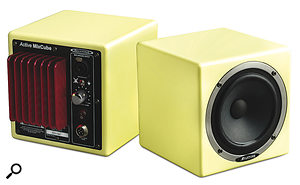
My second suggestion is to get hold of a pocket-size, single‑driver mixing speaker (such as Avantone's Mix Cube, pictured, or Pyramid'south Triple‑P), and apply it to listen to your mix in mono. The additional insight into your mix balance this kind of monitoring provides in dwelling‑studio environments is extraordinary, and well worth the additional outlay, especially if you don't take the budget for proper nearfields and are thus obliged to deport out your mixing work primarily on headphones.
As far equally monitoring technique is concerned, the main matter to remember is to listen at a variety of different monitoring levels, and to take regular breaks to go on your ears every bit fresh as you lot can. Switching between different monitoring systems while working can aid improve your objectivity too.
Mix Referencing
One of the best mixing aids is probably already sitting on your shelf: your own tape collection. About the cheapest way to improve your mixing is to take the time to line up your favourite commercial productions against your own work (matching the loudness if necessary, to enable a reasonable comparing). What amazes me, though, is how few home mixers take the fourth dimension to exercise this in anything more than than a cursory manner. I defended a whole commodity to this subject dorsum in SOS September 2008 (/sos/sep08/manufactures/referencecd.htm), but the most of import thing to recollect is just to take your time selecting suitable reference tracks, and so that you lot set yourself the about challenging goal. Although the reality of continually struggling to reach such a loftier benchmark may feel a bit depressing at times, there's zippo to beat out information technology when information technology comes to ensuring that you lot always reach a solid quality level.
Further Reading
In that location's simply and so much I can cram into an article like this, so on the SOS web site I've placed a list of useful SOS articles that go into much more detail about how to tackle the 10 'mistakes' described here. This includes a number of Mix Rescue features, complete with audio examples.
/sos/sep11/manufactures/mixmistakesreadinglist.htm

Source: https://www.soundonsound.com/techniques/mix-mistakes
Posted by: herseymajessis.blogspot.com
0 Response to "How To Clean Up "Muddy Mixes" "Pdf""
Post a Comment